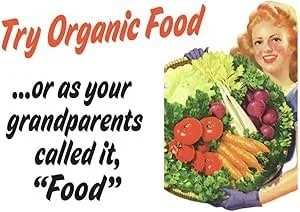
Question: Why on Earth would two seemingly normal bakers insist that they do things the exceptionally hard way by offering only organic, fully scratch made baked goods?
Answer: Because we all deserve BETTER
The Case for Organic Food
THE FACTS
1) More than 10,000 chemicals and additives are currently allowed in the U.S. food supply. This number includes preservatives, dyes and flavoring agents. The European Union currently allows 400.
2) Many of these chemicals and additives have not been thoroughly tested and reviewed for safety.
3) There are potential health harms associated with some of these chemicals and additives. There are also potential health harms associated with the methods in which our foods are produced. Have you noticed how many people aren’t feeling great these days? Allergies, autoimmune conditions, behavioral problems and digestive concerns seem to be increasing at a rapid rate.
4) Organic food is produced using methods that comply with organic standards, including restricting the use of synthetic pesticides, herbicides, fertilizers, artificial dyes and bioengineered ingredients.
5) Organic food costs more. It’s an absolute crime that it does (don’t get us started because we won’t be able to stop) but that’s reality. For our family, eating clean is essential and we consider organic food to be a form of health care.
6) Organic bakeries, like Hopkins Baking Company, use raw organic ingredients to produce wholesome treats. Let’s face it, a bakery is not a health food emporium. But if you are going to splurge and have dessert, why not make it as clean as possible?
7) Organic baked goods taste better. FACT. Real butter, real cream, real sourdough starter. It all makes a difference that you can absolutely taste.

Don’t Feel All That Good? Do You Know What’s Inside Your Snack?
Here are just some of the baking industry’s biggest offenders that you will ABSOLUTELY NOT find at Hopkins Baking Company
Potassium Bromate
Additive that strengthens dough, allowing it to rise higher
Artificial Colors Red No. 3, Red No. 40, Yellow No. 5 and Yellow No. 6
Studies have shown these colors are the most widely consumed, making food aesthetically appealing
Associated with inattentiveness, hyperactivity and restlessness in children
*GOOD NEWS - the HHS is working to ban the use of these dyes (and a few additional colors) as of April, 2025. Some big food companies have already committed to phasing these dyes out, opting to use natural alternatives.
Propyl Paraben
Preservative that extends the shelf life of prepackaged baked goods
Can interfere with hormones, the reproductive system and is linked to various cancers
Aspartame
Found in most sugar free baked goods and confections
High Fructose Corn Syrup
This cheap and highly processed sweetener is made from corn starch and can be found in many baked goods and candies
Butylated Hydroxyanisole (BHA)
Additive used to prevent fats and oils from spoiling
Listed as a known carcinogen under California’s Proposition 65
*GOOD NEWS - the FDA is trying to ban this one as of February, 2026
Azodicarbonamide (ADA)
Makes large quantities of doughs easier to handle, final product rises higher
Seed Oils
Cheap, vegetable based oils (canola, for example) that are often refined using chemical processes that strip away nutrients
Titanium Dioxide
Found in most cake decorations and candies, this white pigment brightens other colors making food appearance more appealing
Bleached Flour
The bleaching process involves treating flour with chemicals like chlorine gas or benzoyl peroxide to achieve a whiter color, softer texture and finer grain.
Can elevate inflammation and act as a tumor promoter as well as adversely affect liver health
The Ugly Truth About GLYPHOSATE
Ask yourself the million dollar question that so many of our customers are asking… “Am I really gluten intolerant or am I actually glyphosate intolerant?”
THE FACTS
Glyphosate is a mineral chelator, so when applied, it binds to key minerals in the soil where our crops are grown. Meaning, glyphosate strips away the key minerals that our bodies need for healthy life. Yes, very sadly, a 1982 ear of corn contained significantly more nutrition than a 2026 ear of corn does.
Glyphosate can be found in over 750 products in the United States, and is the predominate ingredient in Round Up.
Glyphosate is typically used as a weed killer in conjunction with Round Up Ready crops. Round Up Ready crops are genetically engineered, glyphosate tolerant crops. So you can spray Round Up on and around your crops and it will kill the surrounding weeds, not your produce.
Were you a child of the 80’s like us? How many of your friends were gluten free back then? This might just be the culprit for the change: in 1974, approximately 1.4 million pounds of glyphosate were used in the United States, with farms using 57% of that total amount. By 2014, 276 million pounds of glyphosate was used in the US with farms using nearly 90% of the total amount.
Some farmers use Round Up as a desiccate, drying the wheat before harvest. Once dry and harvested, the wheat is not cleaned or rinsed before processing.
Traces of glyphosate can be found in prepackaged cereals, crackers, baked goods and snacks as well as non-organic produce and even meat that was fed GMO corn and soy.
Negative health side effects from glyphosate ingestion can include gut microbiome alterations (hello organic sourdough, thank you for coming to the rescue!), digestive problems, endocrine disruption, infertility, kidney and liver damage, chronic inflammation, weakened immune system and increased risk of cancer. In fact, as of March 2026, the maker of Round Up (Monsanto, now Bayer) has settled almost 100,000 lawsuits, paying almost $11 billion in damages. It is estimated that 61,000 active lawsuits are still pending.
Glyphosate is a major player in the herbicide game and worth learning more about, but it is definitely not alone. There are over 17,000 different pesticides, herbicides and fungicides currently registered for use in the United States.
Hopkins Baking Company is run by bakers, not doctors. We can’t stress this enough. You are always encouraged to take medical advice from the medical professionals and take cinnamon rolls from the baking professionals.
HOPKINS BAKING COMPANY OBSERVATION: we have a growing list of customers that have experienced past gastrointestinal upset and have been told by their doctors to follow a gluten-free diet, but can also somehow eat and enjoy our baked goods without experiencing any negative symptoms. We are talking cupcakes, cookies, scones and bread, all made with organic ingredients and flours and loaded with gluten.
So, once again, the question is…
Are you really gluten intolerant or are you actually glyphosate intolerant?
Don’t be fooled!
The following packaging buzz words sound really good (and can sometimes be a step in the right direction), but aren’t really organic
-
Free Range is a method of farming where the animals are exposed to natural sunlight and are able to roam freely for at least part of the day.
We have no doubt that Free Range animals live better lives than those that remain confined indoors all day. The problem is that the term “Free Range” doesn’t explain what pesticides, herbicides or chemicals the animal’s environment is possibly treated with. Free Range also doesn’t address the possible use of growth hormones and/or antibiotic treatments the animals may be receiving before processing.
-
Another term that implies improved animal care, which is great. However, technically “Grass Fed” tells the consumer nothing about potential pesticide and herbicide exposure the animal may have experienced.
-
We have unfortunately seen the word “Sustainable” used on many products that feature partially recycled packaging (which is great for the Earth) wrapped around an ultra processed, food chemical laden dessert (which is the very opposite of great for our fellow humans).
-
As opposed to what…?!
-
A Genetically Modified Organism (GMO) is a plant, animal or microorganism that has been subjected to biotechnology. This means that techniques such as the modification of genetic sequences are used to change an organism’s genetic material (creating, for example, herbicide resistant soybeans). Bioengineered food ingredients are usually created from processed GMO’s.
While Non GMO is definitely another step in the right direction, it is not synonymous with organic.
-
Gluten Free does not automatically mean organic. You can absolutely choose organic options (and we hope that you do) but the two terms are not interchangeable.